





By Alex Adum
There was a time when colonial expeditions came with ships, soldiers, and sermons. Today, they come with spreadsheets, export credit facilities, and something far more efficient than gunboats: guaranteed returns.
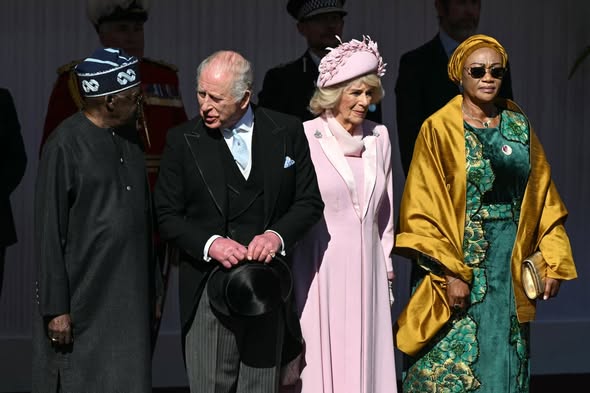
Enter Bola Ahmed Tinubu, who recently embarked on a royal courtesy visit to King Charles III, a trip so productive that one might wonder whether Nigeria attended as a sovereign nation or as a subcontractor in its own economy.
The headline achievement, a £746 million “deal” a word here used in the same generous spirit as one might describe a lion’s lunch arrangement with an antelope.
The £746 Million Masterstroke (Or Masterclass In Reverse Engineering Value)
Under this grand arrangement, the United Kingdom, through its ever-benevolent financial arm will fund the refurbishment of Nigerian ports in Lagos. But in a twist that would make even the most seasoned magician blush, a substantial portion of that money will boomerang neatly back to British companies.
You see, Nigeria gets a loan. Britain gets the jobs.
Nigeria gets infrastructure. Britain gets the contracts.
Nigeria gets the debt. Britain gets the dividends.
And somewhere in this elegant circulation of capital, Gilbert Chagoury smiles, the quiet smile of a man who understands that the shortest distance between public policy and private profit is a well-paved political corridor.
Through companies like Hitech, the ports will be refurbished, using British steel, financed by British guarantees, structured by international banks, and repaid, inevitably, by Nigerian taxpayers who may never see Apapa without traffic but will certainly feel it in their pockets.
It is globalization at its finest: capital travels first class, while accountability remains stuck in Lagos traffic.
The Steel Deal: When National Development Becomes Foreign Policy
Let us admire the poetic symmetry.
Britain launches a Steel Strategy to revive its domestic industry.
Nigeria signs a deal to import British steel.
A struggling sector in Sheffield finds salvation in a “development project” in Lagos. Somewhere, an economist sheds a tear, not of sorrow, but of professional admiration.
Because this is not just trade. It is choreography.
The Second Deal: Human Exports, Now Streamlined
But wait, there’s more.
In what must surely qualify as the diplomatic equivalent of a two-for-one offer, Nigeria also agreed to make it easier for the UK to deport its “undesirables” overstayers, failed asylum seekers, and assorted inconveniences to British immigration policy.
No more bureaucratic delays. No more waiting for documents. Just swift, efficient returns, like defective goods sent back to the manufacturer.
One can almost hear the subtext:
“Thank you for taking our loans; kindly also take back your people.”
Here, Nigeria plays an unexpected dual role: debtor nation and logistical partner in border control.
The UK secures its borders.
Nigeria secures… returning citizens.
The Chagoury Constant
And threading through this tapestry of mutual benefit (mutual, that is, in the way a seesaw benefits both sides, one up, one down), is the persistent gravitational pull of Gilbert Chagoury.
In many political systems, influence is whispered. In this one, it appears to have acquired a project management office.
Is it Infrastructure contracts?
Is it Strategic alignment with foreign capital? or
Proximity to power and influence?
Naturally, it is a new model of efficiency: why lobby from the outside when you can design the inside?
UK: Win-Win Chagoury: Win Nigeria: Please Hold
The official narrative calls it a “strategic partnership.” And indeed, it is strategic, just not in the direction many Nigerians might have hoped.
Because partnerships, in their purest form, imply balance. But this arrangement feels less like a handshake and more like a relay race where Nigeria runs the first lap, hands over the baton, and is then billed for the privilege of participating.
Final Thought: Development or a Well-Dressed Extraction?
Satire aside, one must admire the elegance of it all.
No coercion.
No overt domination.
Just agreements, memoranda, and smiling photo-ops.
The modern extraction economy does not arrive with force; it arrives with financing terms.
And as the ink dries on these historic deals, Nigerians are left to ponder a simple question:
When development is financed, executed, and profited abroad, while repayment is local, is it still development?
Or just colonialism… with better PR, the Chaguory factor and a stronger pound sterling?
Alex Ter Adum, Ph.D, is the Depty Director General of THE NARRATIVE FORCE and writes from alexadum45@gmail.com
2 Responses
Keep educating and inspiring others with posts like this.
It’s refreshing to find something that feels honest and genuinely useful. Thanks for sharing your knowledge in such a clear way.