








By Esther Akaa
Across the agrarian communities of Nasarawa State, women farmers are shifting from backbreaking, low-yield traditional farming to modern, climate-smart agriculture.
Through media field days organised by the Sasakawa Africa Association (SAA-Nigeria) under the SAA-NG country office programme, funded by the NIPPON Foundation of Japan, local women are adopting new techniques that boost crop yields and improve household nutrition across the state.
In Madagba Watta community, Lafia Local Government Area (LGA), Mrs. Felicia Alaku leads a women’s farming group introducing the Orange-Fleshed Sweet Potato (OFSP). Before SAA’s intervention, the community had never known or grown this biofortified crop.
Speaking with this reporter, Mrs. Alaku shared how the organisation helped replace outdated farming habits with methods that deliver higher yields in less time.
”When Sasakawa came, they met with us and introduced this sweet potato variety. They asked if we had ever grown it, and we told them we didn’t know it existed.They taught us to plant at 25 by 25 cm spacing and explained its health benefits specifically how it provides Vitamin A for us and our children,” Alaku said.
Beyond teaching field techniques like 75 cm ridge spacing and soil treatment, SAA trained the farmers on how to prepare the crop to address local nutrient deficiencies.
”They showed us how to cook it step by step.We made porridge, which tasted delicious, as well as juice. They also taught us how to fry it so we can give it to our children for school instead of buying processed snacks,” she explained.
To keep the crop growing year-round, the group set up a dry-season seed stock plot near a community borehole.
”Nobody in this entire area had seen this potato before. We secured farmland near a water source so that after harvest, we can transfer the vines there to maintain our seed stock through the dry season. We won’t let it die out,” Alaku said.
Dr. Moshood Sulaiman, SAA’s Programme Officer for Nutrition-Sensitive Agriculture, emphasised the health benefits of introducing OFSP to rural households.
”This potato is rich in beta-carotene, which the body converts to Vitamin A. It also contains fiber, complex carbohydrates, Vitamin C, potassium, and iron,” Sulaiman said. Our goal is to promote both production and consumption. We trained them to process it into chips, chin-chin, porridge, juice, and flour for tuwo,” Sulaiman said.
In Angwan Iliya, Obi LGA, Mrs. Sarah Joseph leads a farmer group managing a soybean and maize intercropping demonstration plot. She noted a clear difference between their traditional practices and SAA’s climate-resilient approach.
”In the past, when we didn’t know better, we used wide row spacing and harvested very little—hardly a single basket. Now that we use close, narrow rows like on this farm, we expect a strong maize harvest,” Joseph said.
The training also introduced soil restoration methods, including biochar and compost application alongside careful crop management.
”We made biochar by gathering leaves and other organic materials, burning them, and mixing them into the soil before tilling and planting. We are very happy with this training. It shows us how to farm efficiently on smaller land without needing massive fields to get high yields,”she said.
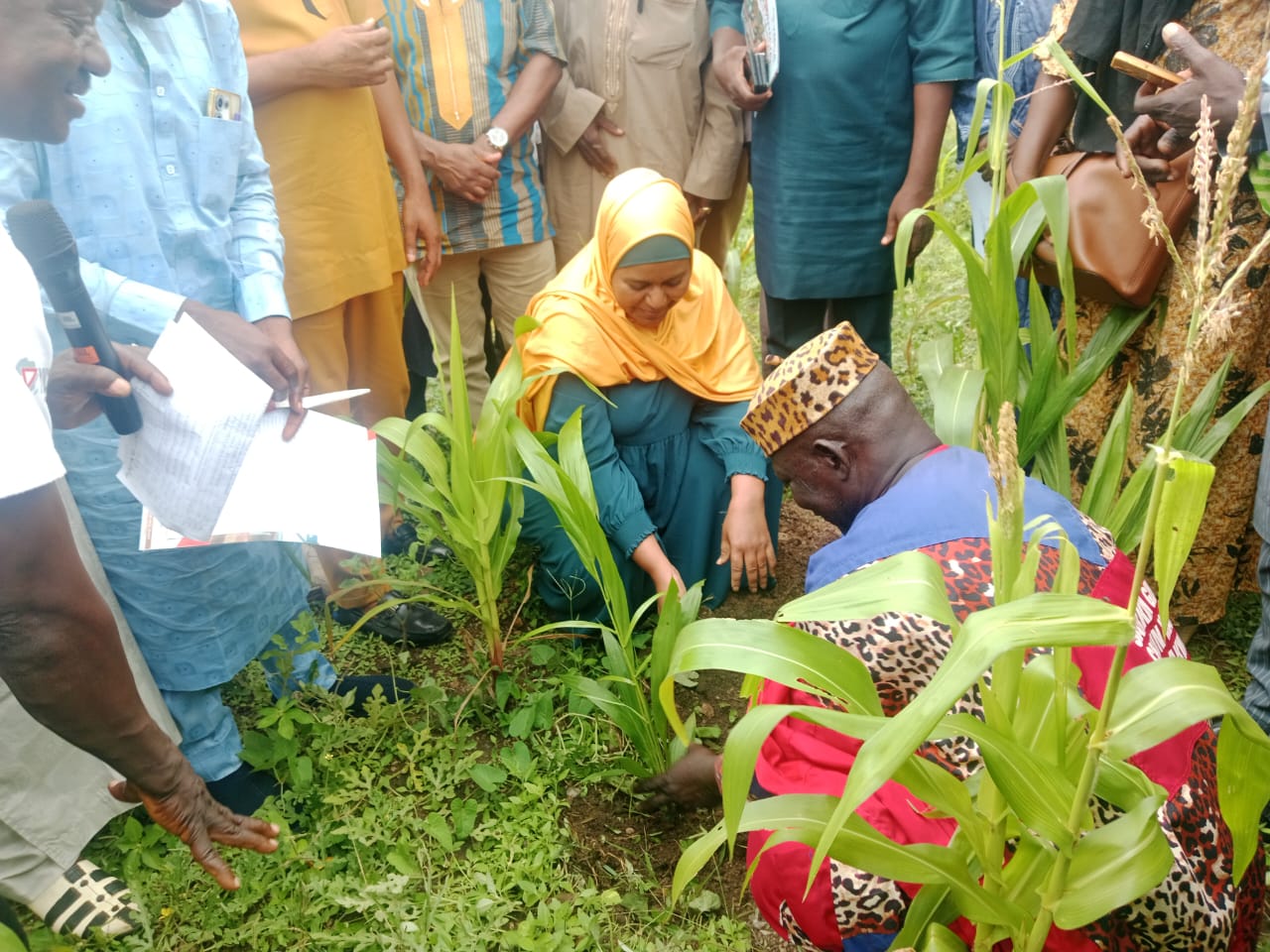
Mr. Nathaniel Otene, SAA’s Coordinator for Climate Resilience and Sustainable Agri-Systems, demonstrated these techniques on a 0.2-hectare Community Demonstration Plot (CDP), highlighting the performance of biofortified SAMMAZ 52 maize intercropped with TGx 1951 soybeans.
”SAMMAZ 52 is a pro-vitamin A maize that matures in about 90 days, helping it withstand early rain cessation and drought. It can yield up to 6 tonnes per hectare, compared to the national average of 2.5 to 3 tonnes. Paired with biochar and integrated pest management, these practices restore soil fertility, retain moisture, and traps carbon in the soil,” Otene said.
In neighboring Angwan Hamidu, Obi LGA, Mrs. Adama Rabiu, leader of another soybean and maize demonstration plot, admitted that community members were skeptical at first.
”When they first showed us the spacing, we wondered if the wind would blow the crops over or if they would yield anything,” But look at how healthy and well-formed the maize turned out,” Rabiu said.
The visual difference caught the attention of passersby:”People driving by stopped to ask if we were masters at growing maize with yields like this. We told them no—an organization called Sasakawa taught us these methods,”she recalled.
Rabiu praised a female field staff, Mrs Salome Sabo who doubles as the SAA Nasarawa State Coordinator from Lafia for guiding them through organic fertilizer production, nursery bed setup, and strict fertilizer timing (NPK at one week, Urea at three weeks). The improvements extended beyond field crops to daily meals.
”Our diet has completely changed. We used to eat very few leafy vegetables, but now we grow fluted pumpkin (ugwu) right around our compounds to add to our soups. It has made a 100 percent difference in our lives,”Rabiu said.
The experiences of Felicia Alaku, Sarah Joseph, and Adama Rabiu show the broader impact of equipping women farmers with climate-smart technologies, practical training, and biofortified crops. Beyond higher yields and healthier soil, these tools improve family nutrition and build stronger community resilience across rural Nasarawa.