
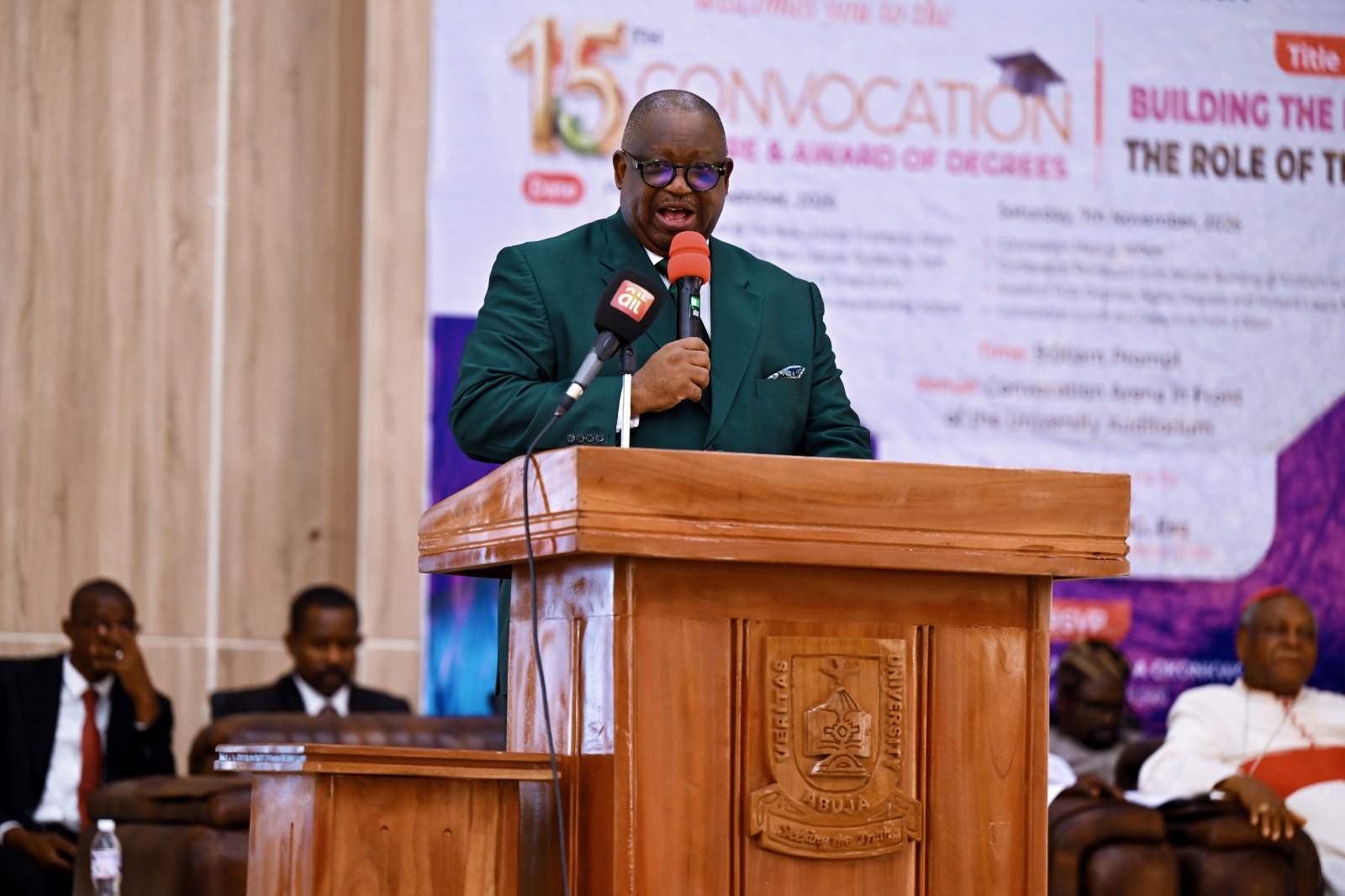



The governor of Plateau State, Barr. Caleb Mutfwang has challenged graduates of Veritas University to use the knowledge and experience garnered in the University to rebuild Nigeria into a nation of their choice.
Governor Mutfwang who was the Convocation Lecturer at the 15th Convocation of Veritas University held on the 6th off November accused educated Nigerians of being responsible for some of the country’s most damaging governance failures, including grand corruption, the manipulation of public institutions and the abuse of public office.
The governor who spoke on the theme “Building the Nigeria We Want: The Role of the Educated Mind,” warned that academic intelligence without integrity has become a threat to national development.
Mutfwang noted that Nigeria’s persistent development challenges could not be blamed solely on a shortage of qualified people, arguing that many of the practices undermining the country’s institutions were perpetrated by individuals with considerable education, professional expertise and technical knowledge.
He challenged graduates to understand that acquiring university degrees carried obligations beyond personal advancement, insisting that education must be demonstrated through integrity, sound judgment and service to society.
According to him, the country’s problem was not necessarily a lack of intelligent people, but the failure to deploy their knowledge and abilities in the interest of the common good.
Mutfwang observed that some of Nigeria’s most entrenched governance challenges were not necessarily the handiwork of uneducated individuals, but often involved people whose education and professional training should ordinarily make them agents of national development.
The governor cited financial fraud, manipulation of public contracts, doctored accounts and the laundering of public funds as examples of how intelligence and professional expertise could be deployed for destructive purposes.
He said: “Indeed, I make an uncomfortable observation: the afflictions I diagnosed earlier, prebendalism, the privatisation of public office, grand corruption, the capture of institutions, are almost never the work of illiterate minds. They are overwhelmingly executed by educated minds.
“The contract, the doctored account, the laundered fund, the ingenious evasion of law. All these are the signatures of trained minds. This is the paradox we must confront. The educated mind is at once our greatest hope, and when corrupted, it becomes our most sophisticated danger.”
Mutfwang also described internet fraudsters as examples of intelligence wrongly applied, arguing that intellectual ability without moral discipline could become an instrument of exploitation rather than progress.
“The Yahoo boy is certainly not a derelict. He is a work of intelligence, but intelligence wrongly applied,” he said.
The governor maintained that Nigeria had never lacked brilliant citizens, noting that Nigerians continued to excel in different professions and fields across the world, but lamented that intellectual ability had too often failed to translate into integrity and public service.
Mutfwang consequently urged the graduating students to reject the temptation to use their qualifications for personal enrichment at the expense of society, stressing that an educated mind must be guided by conscience.
“Knowledge tells you what you can do, but conscience tells you what you should do. An educated mind without a formed conscience is not an asset to any nation. It is a very efficient danger.”
He identified integrity, responsibility and competence as essential qualities graduates must demonstrate if Nigeria is to overcome its development challenges.
On responsibility, the governor said educated citizens must be willing to accept the consequences of their actions rather than hide behind good intentions as he cited the principles in The Ethics of Responsibility saying, “We must possess the willingness to own the consequences of our actions, and not merely the purity of our intentions.”
He also challenged graduates to develop practical skills and the capacity to deliver results, arguing that Nigeria needed people who could translate good intentions into measurable achievements.
“Our nation is not short of people who mean well. It is short of people who can do well, who marry the will to the skill,” he said.
Beyond the responsibility of graduates, Mutfwang called for a collective commitment to building a country anchored on accountable leadership, functional institutions, the rule of law and the protection of citizens’ rights.
He said the Nigeria citizens desire should be one where hospitals provide effective healthcare, courts dispense justice, schools deliver quality education and public office holders serve the people rather than pursue personal interests.
“The Nigeria we want is a nation of institutions that work, where the hospital heals, where the courts deliver justice, where the schools teach, and public office serves truly the public.
“It is a nation where merit is rewarded and mediocrity is not enthroned, where security is felt in the farm, in the market, at home, where prosperity is shared rather than captured, and where leaders understand office as stewardship and not as a spoil,” he said.
The governor, who described himself as a firm believer in Nigeria’s unity, said the country’s diversity should not prevent citizens from working towards a common national purpose.
He said although corruption, ethnic polarisation, dependence on oil and weak institutions had undermined national development, Nigerians could still transform these challenges into opportunities for renewal.
“I do not share the view that the amalgamation of 1914 was necessarily a mistake. I acknowledge our extraordinary diversity and the fact that our peoples have distinct histories, distinct languages and distinct identities. Yet I believe God has a purpose for bringing us together. Our responsibility is to decide what we will make of this country,” he said.
Mutfwang insisted that the Nigeria of citizens’ aspirations was achievable but would require deliberate action, patience and a generation willing to take responsibility for the country’s future.
“The Nigeria we want is buildable. What is required is not a miracle. It’s not a prayer meeting, but a generation of educated minds willing to do the building,” he said.
He further warned against the growing tendency of competent and principled citizens to withdraw from public affairs because of frustration with the country’s political and governance challenges.
According to him, abandoning public life to individuals without the requisite commitment to national development would further weaken the country’s institutions.
“One reason our public square so often disappoints is that too many good people have vacated it, abandoning it to those least fit to occupy it.
“Government and public service are not dirty words. They are the arenas in which the future of a nation is decided. If the best remain outside, the worst will not,” he said.
The governor urged graduates to participate in nation-building regardless of their chosen professions, noting that meaningful change could begin with ordinary decisions to uphold professional ethics and serve humanity.
He said national development was not the exclusive responsibility of political office holders, but depended on the conduct of citizens in classrooms, hospitals, courtrooms, offices, workshops and markets.
“Nigeria is not built only in Abuja or in government houses. It is built in every classroom where a teacher refuses to sell a grade; in every clinic where a nurse treats the poor with dignity; in every courtroom where a lawyer refuses to take a bribe; and in every office, workshop and market where an educated person simply does the right thing, does it well and does it without seeking applause,” he said.
On the growing migration of young Nigerians in search of better opportunities abroad, Mutfwang acknowledged the pressures driving the trend but urged graduates not to completely disconnect from their country.
He advised those who leave Nigeria to contribute to its development through investment, knowledge transfer, mentorship and other forms of support.
“Stay and build, I urge you. And if you must go, remain connected by contribution. The nations you admire were not built by their finest people departing.
“If your path leads you abroad, let your success lead from work, in knowledge, in investment, in mentorship, and a stubborn refusal to write off your country, this country, our Nigeria.
“Your education has placed you in debt to society. Whether or not you feel it, someone taught you who was once taught. Institutions were built for you by hands that are now frail and still. A society made room for you to grow. A gift creates an obligation to give,” he said.
While urging the graduands not to regard their certificates as evidence of superiority over others, but as a responsibility to contribute to the advancement of their communities, Mutfwang argued that every educated Nigerian had a leadership responsibility to influence society positively through personal conduct and professional integrity.
“The Nigeria we want will not descend upon this generation as an inheritance. It must be built deliberately and patiently, institution by institution, hand by hand.
“It will either be built or lost through the daily choices of educated minds like those seated before me today,” he said.
In his remarks, the Vice-Chancellor of Veritas University, Rev. Fr. Hyacinth Ichoku, said government must take greater responsibility for creating an enabling environment that would encourage young Nigerians to remain in the country and contribute to its development.
Ichoku said insecurity, poverty, inadequate infrastructure and unreliable electricity were among the major challenges discouraging young people from pursuing their ambitions in Nigeria.
“If the environment is hostile like we have it currently in many places, nobody would like to stay. The dream you have to achieve will not be realised in a hostile environment.”
He explained that young people naturally gravitated towards places where they believed they could achieve their ambitions, adding that the country’s development depended on its ability to harness their potential.
“Every young man or woman has a lot of dreams to realise and wherever they realise it, wherever they feel they can realise, they migrate to that place,” he said.
The vice-chancellor described young Nigerians as the country’s greatest development resource, warning that their potential would remain largely untapped without adequate infrastructure and opportunities.
Ichoku also admitted that the older generation had not done enough to provide the conditions necessary for young Nigerians to thrive.
He specifically cited persistent electricity challenges, poor roads, insecurity and widespread poverty as factors contributing to young people’s frustration with the country.
“When we have all these insecurity around us, when we can’t even fix simple things like electricity other nations have fixed, when we can’t fix our roads, then the youth feel disappointed,” he said.
The vice-chancellor acknowledged that although successive governments and previous generations had made some progress, much more needed to be done to reverse the growing frustration among young Nigerians and create an environment where they could realise their aspirations at home