
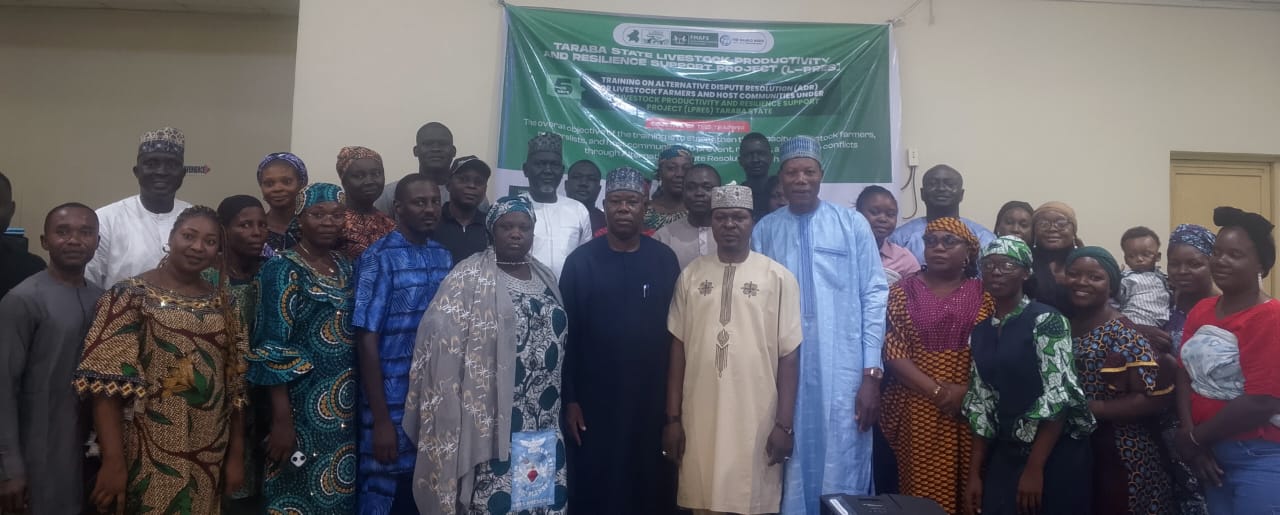








To stem recurrent clashes over land, water resources, and grazing routes, the Taraba State Livestock Productivity and Resilience Support Project, L-PRES, has commenced a five-day intensive workshop on Alternative Dispute Resolution, ADR, for pastoralists, crop farmers, and grassroots community leaders.
The capacity-building exercise, held in Jalingo, aims to entrench non-violent, dialogue-driven mechanisms to de-escalate tensions before they trigger violent confrontations across agrarian belts in the state.
Speaking at the opening session 5days workshop, the State Project Coordinator of L-PRES, Mr. Hananiah G. Albert, noted that sustainable livestock development cannot take place in an atmosphere of mutual suspicion and recurring clashes.
Albert, who spoke through the State L-PRES ICT and Communication Officer, Mr. Ezra Atimas, stressed that because agriculture remains the primary livelihood of Taraba residents, friction over shared resources must be resolved through structured engagement rather than confrontation.
He said: “Alternative Dispute Resolution provides disputing parties with a platform to sit together, listen, and understand one another’s grievances with the goal of arriving at mutually beneficial solutions.
“Effective communication and early intervention are essential to preventing minor farm-level disagreements from snowballing into wider communal violence.
“Strengthening social cohesion between pastoralists and host communities will not only guarantee rural security, but also unlock the full commercial potential of the livestock sub-sector.”
Also speaking, a lead resource person and Dean of the Faculty of Social Sciences at Taraba State University, Dr. Danjuma Yusuf, charged participants to leverage existing traditional leadership institutions in dispute management rather than resorting to self-help.
Yusuf and other facilitators advised that mediation processes should actively integrate traditional rulers, religious clerics, women’s groups, and herder associations to inspire mutual trust and enforce binding resolutions.
He added that ADR should be embraced primarily as a proactive, preventive strategy to identify and douse simmering grievances around cattle movement, water access, and crop damage before open conflict breaks out.