


The Chief Whip of the House of Representatives between 1999 to 2007, Alhaji Abubakar Bawa Bwari has dismissed as inaccurate, the allegation by former President Olusegun Obasanjo that former speaker of the House of Representatives, Late Ghali Umar Na’Abba received Five Million Naira Bribe from Atiku Abubakar to commence impeachemnt proceedings against him.
President Obasanjo alleged recently that his former Vice President, Atiku Abubakar bribed Ghali Na’Abba with five Million Naira to impeach him as president, an allegation the former Vice president Strongly denied.
But weighing in on the matter, Hon. Bwari who served in the House of Representatives as Chief Whip from 1999 to 2007 and was seen as Na’Abba’s top confidant said the former president’s allegation was “ufair and inaccurate.
“President Obasanjo’s assertion that former Vice President Atiku Abubakar offered Ghali Na’Abba N5 million to instigate impeachment proceedings against him is not only unfair and inaccurate, it is a claim that collapses under the weight of its own logic. As the Chief Whip of the House of Representatives during that foundational era, I did not merely observe these events; I lived them. I was at the nerve centre of our daily deliberations. With respect, Chief Obasanjo himself knows that I know the real details of what transpired.
“In any case, one must ask a fundamental question: Is Chief Obasanjo suggesting that the presidency of the Federal Republic of Nigeria was worth so little? Even by the economic standards of the early 2000s, such a sum defies the mechanics of a National Assembly. It is trite law that a Speaker, no matter how influential, cannot single-handedly remove a President. It requires a constitutional two-thirds majority of the entire House, followed by a rigorous, concurrent process in the Senate. Was this N5 million therefore intended for Ghali alone, or was it meant to be distributed across 360 members of the House and 109 Senators, and Senate President Anyim Pius Anyim, to purchase a constitutional coup?” he queried.
According to him, “the arithmetic of the proposition is absurd, especially when one considers the fact that those willing to support the Third Term Agenda of Obasanjo were given N50 million each. Besides, Ghali was far too sophisticated a political scientist, and far too deeply principled an institutionalist, to ever engage in an enterprise so hollow. He was simply too committed a democrat to dabble in such shenanigans. If anything, his Speakership was the one constantly assailed by fifth columnists sponsored by the executive to remove him. Indeed, on one occasion we were forced to take the extraordinary step of displaying, on the floor of the house, the money some members took from the presidency as inducements to impeach Ghali from office”.
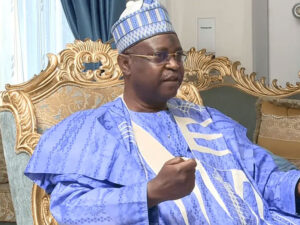
The statement entitled Setting the Record Straight: A Gentle Correction to Obasanjo’s Claims on Ghali Na’Abba reads:
Let me state at the outset that we recognise that the original intention of former President Olusegun Obasanjo’s letter was to reply to what he called “the inaccurate posture” of former governor Segun Osoba in an article titled, “How Obasanjo Deceived Us In 2003.” His subsequent maligning of the late former Speaker, Rt. Hon. Ghali Umar Na’abba, therefore falls under what may be termed unintended consequences.
Initially, many of us in the leadership of that historic House of Representatives felt a strong inclination to simply ignore the former president’s recent letter. Over the years, the public has largely come to take these periodic epistles by the man less seriously, viewing them more as political theater than objective history.
However, it is possible that there are still people who see the former president as the sole custodian of national integrity. For their sake, and because a lie unchallenged can easily morph into accepted history, we cannot remain silent. Ghali Na’Abba may no longer be here to speak for himself, but his legacy lives on, and his friends, colleagues, and fellow defenders of the legislature are obligated to protect it.
To those of us who served during his presidency, Chief Obasanjo remains an institutional father figure, a leader of global consequence, and someone for whom I personally retain a deep, abiding personal affection. It is precisely because of this profound respect for him, and the unique closeness we shared during those turbulent years, that I feel a compelling duty of honour to gently correct a narrative that does a grave injustice to the memory of our late former Speaker and my dear friend.
President Obasanjo’s assertion that former Vice President Atiku Abubakar offered Ghali Na’Abba N5 million to instigate impeachment proceedings against him is not only unfair and inaccurate, it is a claim that collapses under the weight of its own logic. As the Chief Whip of the House of Representatives during that foundational era, I did not merely observe these events; I lived them. I was at the nerve centre of our daily deliberations. With respect, Chief Obasanjo himself knows that I know the real details of what transpired.
In any case, one must ask a fundamental question: Is Chief Obasanjo suggesting that the presidency of the Federal Republic of Nigeria was worth so little? Even by the economic standards of the early 2000s, such a sum defies the mechanics of a National Assembly. It is trite law that a Speaker, no matter how influential, cannot single-handedly remove a President. It requires a constitutional two-thirds majority of the entire House, followed by a rigorous, concurrent process in the Senate. Was this N5 million therefore intended for Ghali alone, or was it meant to be distributed across 360 members of the House and 109 Senators, and Senate President Anyim Pius Anyim, to purchase a constitutional coup?
Clearly, the arithmetic of the proposition is absurd, especially when one considers the fact that those willing to support the Third Term Agenda of Obasanjo were given N50 million each. Besides, Ghali was far too sophisticated a political scientist, and far too deeply principled an institutionalist, to ever engage in an enterprise so hollow. He was simply too committed a democrat to dabble in such shenanigans. If anything, his Speakership was the one constantly assailed by fifth columnists sponsored by the executive to remove him. Indeed, on one occasion we were forced to take the extraordinary step of displaying, on the floor of the house, the money some members took from the presidency as inducements to impeach Ghali from office.
Simply put, the internal dynamics of the House at the time paint a completely different picture. The House leadership was actually quite wary of Vice President Atiku Abubakar during those specific standoffs. We viewed him not as an ally in any impeachment drive, but as President Obasanjo’s chief envoy and defender. Whenever the friction between the executive and the legislature reached a boiling point, it was Atiku who frequently appeared at our doorsteps, speaking passionately on OBJ’s behalf to douse the flames. How the man who acted as the President’s primary shield became, in this retold history, the architect of an underfunded bribery plot to unseat him is a paradox that defies reason.
It is surprising that former President Obasanjo now claims he was unruffled by the attempt of the House to impeach him, and that former president Shehu Shagari had, on his own volition, without any prompting from him, decided to intervene on his behalf. This is simply not true. In those days, we were not playing, and the House had compiled dozens of impeachable offenses against the President and was determined to commence proceedings against him. Ghali, and indeed a great many active members of the House, were implacable and I vividly recall the intense anxiety of those days, and the lengths to which the presidency went to find a diplomatic resolution.
Obasanjo knows for a fact that he initiated, or at least endorsed, multiple high-level delegations to mediate with the House leadership. Apart from the revered former President Shagari, whom he mentioned in his letter, I remember that a number of other diverse and powerful delegations came to plead his case to us. Incidentally, Alhaji Shagari did not come alone, he arrived together with General Yakubu Gowon, who is alive, so why didn’t Obasanjo mention his name, or does he only inveigh against people who can no longer speak for themselves?
I clearly recall another intercession by a royal delegation led by the late Ooni of Ife, Oba Okunade Sijuwade (Olubuse 11) and the late Emir of Kano, HRH, Alhaji Ado Bayero. There were actually others, including the elder statesman, Chief Anthony Enahoro, former vice president Alex Ekwueme, and Brigadier Abba Kyari, rtd.
There was even an intervention by a delegation of six governors representing the geopolitical zones, led by Chief Segun Osoba himself, ironically, the very same Osoba whose recent correspondence with Obasanjo provided the opportunity for this latest romp in historical fallacy.
When official channels were needed, the President’s then Chief of Staff, Major General Abdullahi Mohammed, intervened directly on his behalf. Other key emissaries like Alhaji Damcida, Ambassador Zakari Ibrahim, and former influential House Committee Chair on Rules and Business, Hon. Musa Elayo who had then become Nigeria’s Minister of State for Justice, were all dispatched to meet with House leadership on Obasanjo’s behalf to sue for peace. We engaged in those late-night dialogues with the utmost seriousness because we respected the presidency, even as we fiercely guarded the independence of the legislature.
Ghali Na’Abba’s battles with the executive were never personal, nor were they transactional. He was driven by an unyielding devotion to the doctrine of the separation of powers. He believed, with every fiber of his being, that for Nigerian democracy to survive its infancy, the legislature could not afford to be an appendage of the executive. He fought valiantly for constitutional integrity, and the democratic credentials we enjoy today were forged in the fire of his stubborn refusal to compromise institutional honour.
In sum, we did what we did under his leadership for purely ideological reasons. We did not seek bribe nor were we willing to accept it in order to become a rubber stamp legislature. We fought a gallant fight and suffered for it; a great many of us, including Ghali, were denied the ticket to return to the parliament or win primaries, and posterity will judge us fairly for doing the best we could in the circumstances.
Former Vice President Atiku Abubakar has suggested that former President Obasanjo’s recent remarks are merely an early volley in the battle for the 2027 presidential elections, in support of a particular candidate. I cannot speak to the veracity of the man’s political motivations, although the timing is indeed very suspicious. My sole concern is the sanctity of memory.
The alleged bribe story, as fabulous as they come, is said to have occurred sometime between 1999 and 2003. Yet, for the best part of two decades, while Ghali was alive, unrepentantly defiant, and famously articulate, this accusation was never brought to light. For former president Obasanjo to introduce it now, when the “lion” has passed on and cannot offer his characteristic, brilliant rebuttal, feels deeply unfair, an unconscionable betrayal.
Chief Obasanjo is an elder statesman of immense stature, and as he advances in years, his words carry the heavy weight of history. We respect his remarkable contributions to our nation, and we want his legacy to remain untainted by unnecessary political peregrinations.
However, for the sake of truth, and out of respect for a legislative giant who served his country with clean hands, let us allow the soul of Ghali Umar Na’Abba to rest in well-earned, undisturbed peace.
Bwari was the Chief Whip, House of Representatives (1999–2007)