

By Mansur Abubakar
For months rumours and secrecy have surrounded last year’s alleged Independence Day coup plot in Nigeria – but with this week’s indictment of six people accused of involvement comes the first details of what is said to have been an elaborate plan to oust President Bola Tinubu.
It was due to take place on 1 October 2025 – the day Nigeria marked the 65th anniversary of its independence from the UK.
But at the very last minute the celebratory parade, to be attended by the president, was cancelled – and the government and military were tight-lipped about why.
It was only in January that the military announced, in a statement short on detail, that 16 unnamed senior military officers were to face a court-martial over an alleged plot – effectively admitting a coup attempt had been thwarted.
Now court documents, filed by state prosecutors at the Federal High Court in the capital, Abuja, have revealed the name of the alleged mastermind and suggest that one of the major aims of the plotters was to destabilise the state ahead of the planned takeover.
The six going on trial at the High Court cannot go before a military court – some are civilians, one in a serving police inspector and others are retired military personnel.
They have denied the 13 charges, including treason, terrorism and money laundering – and while they may not necessarily be the ringleaders, their trial is likely to shed light on an alleged plan that is said to have involved all elements of Nigeria’s security forces.
Nigeria has a long history of military takeovers but has been under civilian rule since 1999. Several other West African countries have experienced coups in recent years and there has been speculation that Nigeria could be next, with economic hardship rising and accusations that the political system was rigged in favour of a small elite.
Who was alleged architect of the plot?
Court documents point to Colonel Mohammed Ma’aji as the alleged chief strategist.
Little is known about the 50-year-old, a Muslim born in western Niger state who spent much of his early army career in the southern oil-rich Niger Delta region and where he climbed the ranks in the mid-2000s.
This was when oil militancy was at its height and heavily armed militants on speedboats were attacking oil installations and kidnapping foreign oil workers for ransom.
He is said to have developed close ties with oil businessman and one-time governor of Bayelsa state, Timipre Sylva, who was instrumental in getting the oil militants to agree to a ceasefire which eventually led to an amnesty in the creeks in 2009.
Ma’aji even co-ordinated security for Sylva during his failed bid to win a second term as governor in 2015, according to several newspaper reports.
It is this relationship that appears to be central to the alleged coup plot.
How was the alleged plot financed?
One of the military investigators, who spoke to the BBC on condition of anonymity, says this is where Timipre Sylva is alleged to come in.
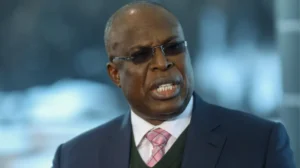
The 67-year-old was not officially indicted this week, but his name appears in seven of the 13 counts – with the words “still at large” written every time he is mentioned.
Sylva served as the oil minister during the final term of President Muhammadu Buhari which ended in 2023, and the investigators believe he was a key financier of this alleged plot to overthrow Buhari’s successor.
He is a member of the governing All Progressives Congress (APC) party but is known not to have backed Tinubu when he stood for president in 2023.
In the wake of the cancelled Independence Day events, Sylva’s house in Abuja was raided by investigators, and at the time his spokesman denied the wealthy politician’s involvement in the alleged plot.
He maintained the allegations and a subsequent arrest warrant issued for Sylva in a separate corruption case were politically motivated.
The spokesman added that Sylva was in the UK for medical treatment and would return home to clear his name. He is yet to do so.
Lots of money would have been needed to buy equipment and favours ahead of the alleged takeover. Several civilians on the charge sheet are alleged to have been given money for their services – figures quoted range from 2m naira (£1,000; $1,500) to 50m naira (£27,500; $37,000) – which it says they “reasonably ought to have known forms proceeds of an unlawful act… terrorism financing”.
What was the alleged plan on the day?
These details are not in the court documents, but the military investigator explained how the conspirators allegedly planned to storm Nigeria’s seat of power, the Aso Rock presidential villa in Abuja, on 1 October.
It is one of the most heavily guarded sites in the country – but the alleged plotters are said to have been able to build up intelligence through insider information. For example, one of the civilians indicted – Zekeri Umoru – was an electrician working at the villa.
After seizing control, the alleged plan was to immediately detain the president and other top officials. The military source further alleged that the plotters intended to assassinate Tinubu, his deputy Kashim Shettima, Senate President Godswill Akpabio and House Speaker Tajudeen Abbas.
Yet concerns about the extent of the alleged plot convinced the military to abandon its parade on 1 October – and investigations and arrests continued afterwards.
According to the military investigator, the suspects are alleged to have procured vehicles, including SUVs, for their operation. These were to be used to get to strategic locations such as airports and other sensitive sites.
Nigeria’s military forces comprise three branches – the army, navy and air force. Within the army there are eight divisions deployed across the country, plus the Presidential Guard to protect Aso Rock.
Of the 16 senior officers arrested, 14 were in the army, believed to be spread across numerous divisions, one in the navy and one in the air force.
Why was a cleric indicted?
Sani Abdulkadir is a name that stands out on the list of civilians indicted. A popular Islamic cleric from Zaria in Kaduna state, he was reported missing in late 2025, with his family appealing for help and giving media interviews.
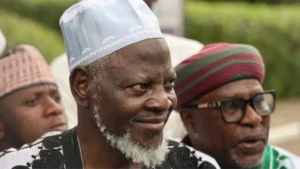
They said he had gone to the capital to find out why his bank account had been frozen and disappeared. It only became clear after several months that he had taken into custody.
On Monday, the Federal High Court ordered that he be freed, awarded him more than $3,500 in damages for human rights violations and told the security agencies to apologise.
However, the next day he was named as one of the coup plot conspirators and has again been detained. The court documents state he received $1,500 from one of the alleged plotters.
According to the military investigator, this was not to preach a radical form of Islam with the end of destabilising the country, but to act as a “spiritual ‘prayer-warrior’ for the operation”.
Abdulkadir is based in Kusfa, the religious centre of Zaria city where the area’s many clerics are known to offer prayers for those who ask – a common custom in northern Nigeria.
Will more people be brought to trial?
This is likely, a legal source close to the investigation has told the BBC.
An in-depth investigation by Nigeria’s Premium Times newspaper earlier in the year listed the names of 40 suspects, the majority of whom were in the military.
On Friday it was announced that the military tribunal was being inaugurated – with reports that more than 30 officers would be tried. However, the proceedings are to be behind closed doors.
Questions are being asked about one of the civilians on the leaked list, who has not appeared in court – famous Nollywood actor and director Stanley Amandi, popularly known as “Stan K”.
In January, the Actors Guild of Nigeria (AGN) confirmed to BBC Pidgin that the filmmaker from the eastern city of Enugu had been arrested after reports that he had been hired as a “propagandist” for the alleged coup.
It is believed Amandi, known for directing popular hits such as The Album and Tiger King and his recent role in Once Upon a Dream, was detained in September.
The legal source said his alleged role was to be that of a public relations operative who would use his media links and film content to win public support for the military takeover.
The AGN’s Emeka Rollas Ejezie said the organisation had been in touch with the Department of State Services (DSS), Nigeria’s domestic spy agency, to organise for his lawyer, wife and doctor to visit him.
However, Ejezie said the DSS officially responded to say the filmmaker was not in their custody but with the country’s military intelligence agency, which has not commented further, despite the AGN’s efforts.
Amandi has not been contactable to comment on the allegations and the AGN remains anxious to confirm his whereabouts.
The six defendants before the High Court were remanded into the custody of the DSS on Wednesday until their next court appearance on 27 April for bail hearings.
The few details that have so far come out about the alleged coup attempt have shocked Nigerians – the country has witnessed several military interventions, but the last successful coup took place in 1993 under Gen Sani Abacha.
Many will be anxious for more information from the trial about what appears to be the first serious coup attempt since the return to democracy in 1999, something commentators say is a worrying development given the recent rash of military takeovers elsewhere in West Africa.
CREDIT: BBCNEWS